


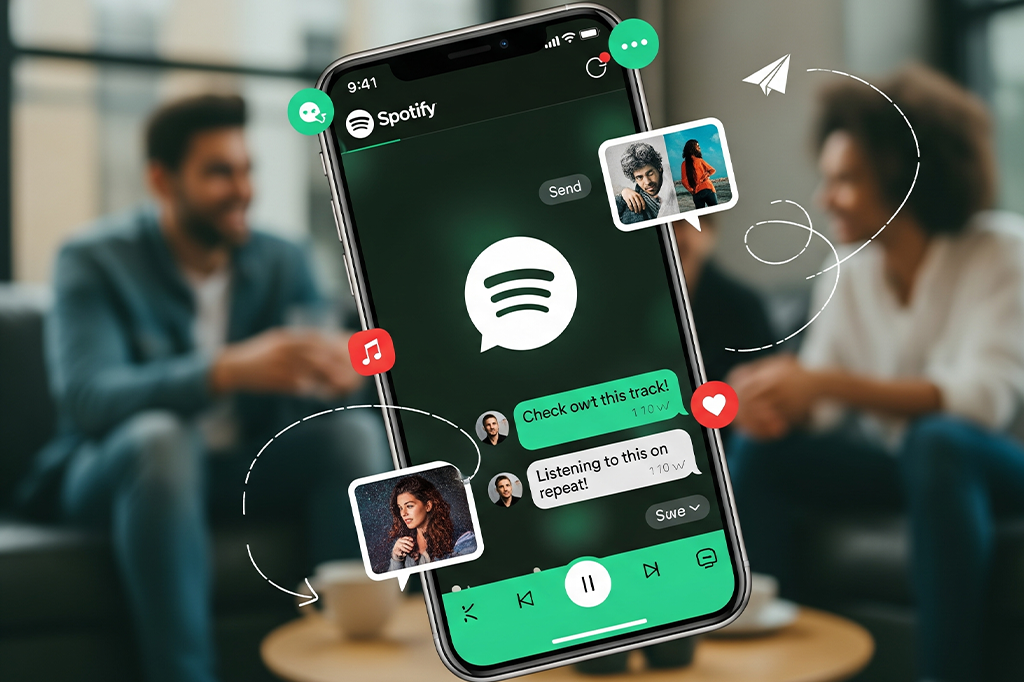
Spotify is taking a big step toward becoming a more social platform. On Tuesday, the music streaming giant announced a new in-app messaging feature designed to let users chat with friends while sharing music and podcasts. While Spotify has allowed sharing links externally for years, the new feature encourages users to stay within the app while keeping a history of shared content for easy access.
This move represents Spotify’s ongoing effort to make the mobile experience more interactive, and it comes as the company competes with both music and social platforms in creating engaging user communities.
Why Spotify Is Adding Messaging
For years, Spotify has offered only a few social elements, like following friends and viewing their listening activity. Last year, the company began experimenting with comments on podcasts and a video-focused feed, signaling a push toward social interaction.
According to Gustav Söderström, Spotify’s Chief Product and Technology Officer, the company aims to create a more interactive consumer experience. The messaging feature aligns perfectly with this goal, allowing users to chat about music, share recommendations, and maintain conversations within the platform.
By integrating messaging, Spotify is hoping to increase user engagement, reduce churn, and offer a more community-driven experience that encourages users to spend more time in the app.
How the Messaging Feature Works
The new messaging tool is designed to be simple and intuitive. Here’s what you need to know:
One-on-One Chats and Approvals
-
Messages are one-on-one. You can only start a chat with someone you’ve previously shared content with—like a collaborative playlist, a Jam, or a Blend.
-
Family or Duo plan members can also chat, but approval is required before conversations can start.
-
Users can manage requests, approve, or deny invitations to chat.
This setup ensures that messaging stays personal and limits spam while still encouraging organic sharing between friends.
Integration with External Apps
Spotify also supports messaging initiation through external apps. If someone sends a Spotify link via Instagram, WhatsApp, Snapchat, Facebook, or TikTok, recipients can tap the link to approve a chat request directly in Spotify. Alternatively, users can send an invite link to contacts outside the platform.
Once a conversation starts, users can react with emojis and track shared content without leaving the app. Conversations appear under the Messages section on the left hover bar in the mobile app.
Privacy and Security
Spotify emphasized that all messages are encrypted at rest and in transit, though they are not end-to-end encrypted. The company will proactively monitor messages to ensure compliance with community guidelines and platform rules. Users can also report inappropriate messages for review.
While some privacy advocates may wish for full end-to-end encryption, Spotify’s approach balances user safety and moderation with usability. Users who prefer not to receive messages can disable the feature in Settings > Privacy and Social.
Initial Rollout and Availability
The messaging feature is rolling out first to:
-
Premium and free users over 16
-
Select markets in Latin and South America
-
Mobile platforms only
Spotify plans to expand the feature to the U.S., Canada, Brazil, the EU, the U.K., Australia, and New Zealand in the coming weeks.
By limiting the initial release to mobile and specific markets, Spotify can gather feedback and usage data to optimize the feature before a global rollout.
Spotify’s Broader Social Strategy
Adding messaging is just one part of Spotify’s broader social expansion:
-
Podcast comments: Last year, users could leave comments on podcasts, sparking discussion within the app.
-
Video-focused feed: Spotify redesigned feeds to include videos, giving creators and listeners more ways to interact.
-
Collaborative playlists and Blends: These features continue to encourage community music sharing.
Spotify’s leadership has indicated that future updates may include comments on music tracks, more interactive experiences, and enhanced social discovery tools.
User Reactions: Excited or Overwhelmed?
Not all users are enthusiastic about increased social features. Some have expressed frustration over the app’s cluttered interface, which they say makes navigation harder. Spotify former employee Amanda Silberling highlighted that the time from home page to music can feel overwhelming due to too many interactive features.
Messaging may encourage sharing and engagement, but it could also add to perceived complexity. The option to disable messages provides users control, but Spotify will need to strike a balance between social interactivity and simplicity.
Why This Matters
The introduction of in-app messaging could significantly change how Spotify users interact:
-
Keeps users in the app: Instead of sharing links externally, conversations and sharing happen within Spotify.
-
Encourages discovery: Friends can recommend songs, podcasts, and playlists in real-time.
-
Builds community: Messaging fosters more personal connections and engagement around shared music experiences.
-
Competitive advantage: Messaging gives Spotify a unique edge compared to competitors like Apple Music, which lacks an integrated chat feature.
Looking Ahead
Spotify’s move toward social interactivity demonstrates a growing trend in music streaming platforms: users want connection, conversation, and shared experiences, not just access to music.
While challenges like interface complexity and privacy concerns remain, in-app messaging could become a key differentiator in Spotify’s battle to retain users and increase engagement.
For now, mobile users in Latin and South America get to test the feature first, but a global rollout seems imminent.
As Spotify continues to refine messaging, the app could evolve into a social hub for music lovers, blending music streaming with real-time conversation and community interaction.
