


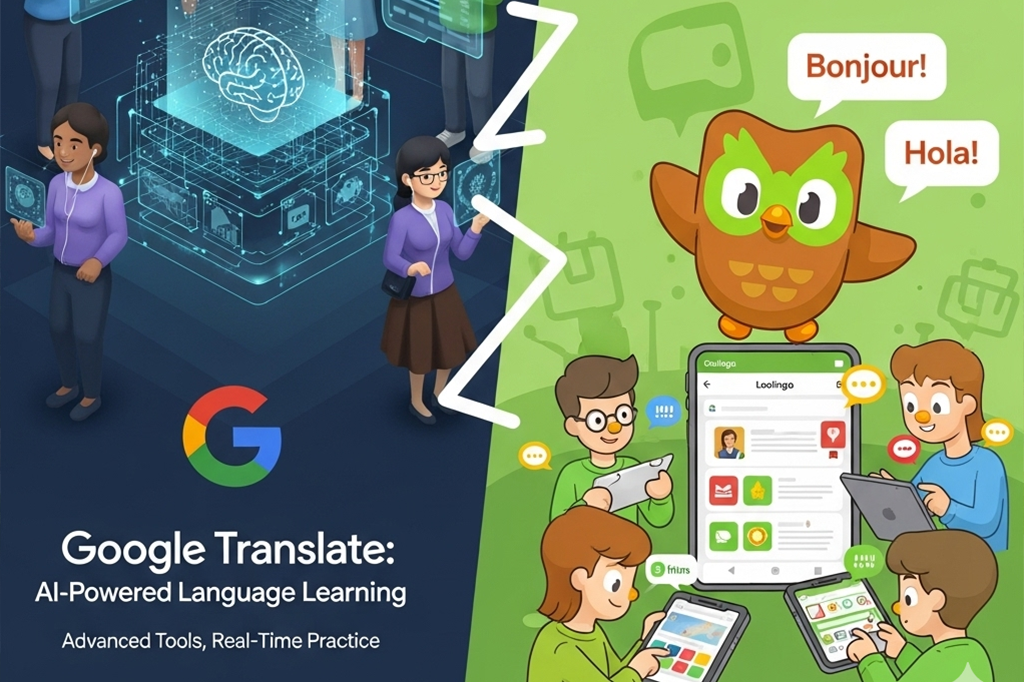
For years, Google Translate has been the go-to tool for instant translations, helping millions of people break down language barriers in real time. But now, Google is stepping into new territory: language learning. With its latest AI-powered experimental features, Translate is expanding beyond simple translations to help people practice, improve, and master new languages—directly challenging Duolingo, one of the world’s most popular language learning apps.
So, what’s new in Google Translate, and how does it compare with Duolingo’s gamified learning system? Let’s take a closer look.
📌 Google Translate’s New AI Practice Tools
Google recently announced a language practice feature that is rolling out in beta on both Android and iOS Translate apps. Unlike traditional translation, this new feature is designed to help users actively learn and practice speaking and listening in a foreign language.
Here’s how it works:
-
Users can select a “Practice” option in the app.
-
They set their skill level (beginner, intermediate, or advanced) and learning goals (conversation skills, vocabulary expansion, or fluency).
-
Google Translate then generates customized scenarios where learners can either:
-
Listen to conversations and tap the words they recognize to improve comprehension.
-
Speak responses to practice pronunciation and fluency.
-
The app tracks daily progress, giving learners a structured way to monitor their improvement.
At launch, the feature is available for:
-
English speakers practicing Spanish and French.
-
Spanish, French, and Portuguese speakers practicing English.
This marks the beginning of a much larger rollout that could eventually cover dozens of languages supported by Translate.
🎮 Google Translate vs. Duolingo: What’s Different?
Duolingo has built a massive following—over 88 million monthly users—with its gamified lessons, streaks, and badges. It covers more than 40 languages and offers both free and premium tiers.
But Google Translate has a unique edge:
-
Instant real-world application: Instead of just learning words through quizzes, learners can immediately use Translate’s live conversation tools to test what they’ve practiced.
-
AI personalization: Translate adapts practice sessions to each learner’s level, goals, and performance, whereas Duolingo follows a more fixed path.
-
Integration with Google ecosystem: Since Translate is tied into Search, Lens, Chrome, and Circle to Search, learners can apply their skills seamlessly across other Google apps.
While Duolingo still has the advantage of community features and fun gamification, Translate is offering a more practical, AI-driven approach.
🗣️ Real-Time Conversation Upgrades
In addition to the practice feature, Google is enhancing its live conversation mode. The new update makes back-and-forth conversations more natural in 70+ languages, including:
-
Arabic
-
French
-
Hindi
-
Korean
-
Spanish
-
Tamil
How it works:
-
Tap the “Live Translate” option in the app.
-
Select your target language.
-
Start speaking—Translate will instantly translate aloud and display transcripts for both languages.
Thanks to AI speech recognition, Translate can now identify pauses, accents, and intonations, allowing conversations to feel smoother and more natural.
This upgrade also makes Translate more reliable in noisy environments like restaurants, airports, or crowded markets—something traditional translation apps often struggle with.
⚙️ Powered by AI and Gemini Models
These new features are fueled by Google’s advanced speech recognition and AI language models, including its Gemini models. According to Google:
-
Gemini has improved translation quality, especially for less common languages.
-
Multimodal translation now supports not just text, but also images and speech.
-
Text-to-speech (TTS) has been upgraded for more natural-sounding voices.
Together, these innovations push Translate beyond its original role as a “dictionary on demand” into a dynamic learning companion.
🌍 Availability and Rollout
-
The language practice feature is in beta and rolling out starting Tuesday.
-
Available initially in the U.S., India, and Mexico.
-
More languages and regions are expected soon.
Google already notes that across Translate, Search, and Lens, people translate 1 trillion words per day. By embedding AI learning directly into Translate, the company is tapping into a massive built-in user base—something Duolingo had to grow from scratch.
💡 Why This Matters
The move is significant for both language learners and the broader AI app ecosystem:
-
Accessibility: Many learners won’t need to download a separate app like Duolingo—they can practice directly inside Translate, which is already installed on billions of devices.
-
AI-powered education: Unlike older apps, Translate is using cutting-edge AI to personalize and contextualize learning, making it feel more natural and less repetitive.
-
Competition in EdTech: Duolingo has dominated the space for years, but Google’s entry with Translate could reshape the future of AI-driven education.
🚀 The Future of Language Learning
With these updates, Google Translate is moving from a passive utility app to an active learning tool. By combining instant translation with structured language practice, Google is bridging the gap between communication and education.
While Duolingo still leads in gamification and community, Translate’s integration of AI-driven real-time practice could prove more useful for learners who want to use a language in real-world conversations.
As AI continues to advance, it’s clear that language learning apps will become smarter, more personalized, and more immersive. Whether you’re a beginner trying to learn basic phrases or an advanced learner brushing up on vocabulary, the future of language practice is going to be AI-powered, interactive, and accessible.
