


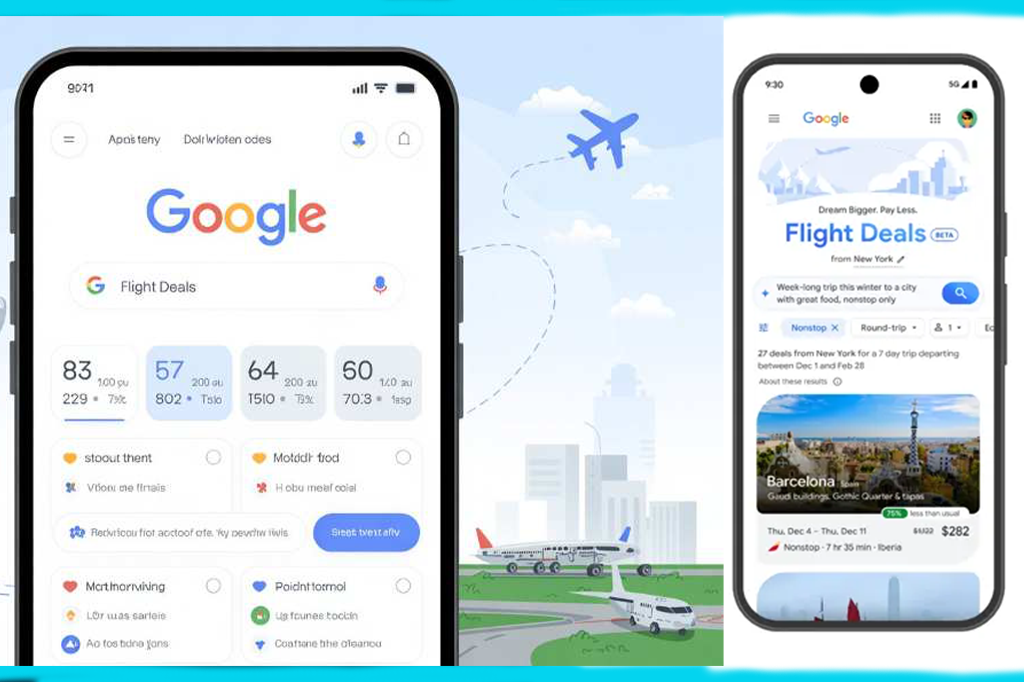
Google Brings AI Into the Skies: Flight Deals for Smarter Travel
Google has officially stepped deeper into the travel industry with the launch of Flight Deals, a new AI-powered search tool designed to help travelers discover cheaper airfares. Built directly into Google Flights, this new feature leverages Google’s Gemini 2.5 AI model to let users type natural language queries such as:
-
“Week-long trip this winter to a city with great food, nonstop only.”
-
“10-day ski trip to a world-class resort with fresh powder.”
The AI then interprets the request, scans available options, and delivers results that highlight the biggest savings. For flexible travelers who care more about price than destination, this could be a game changer.
How Flight Deals Works
Unlike traditional flight search tools that require exact dates and destinations, Flight Deals allows travelers to describe their ideal trip in plain language. Google’s AI parses these requests and surfaces matching destinations, prioritizing results by savings percentage.
Here’s how results are ranked:
-
Highest savings first: Deals with the largest percentage discounts appear at the top.
-
Tie-breaker: If two options have equal savings, the lower absolute price is ranked first.
-
No savings badge: Deals without discounts are ordered by lowest price.
Prices are based on real-time data feeds from airlines and travel partners, and Google confirmed that fares shown in Flight Deals match those found in the existing Google Flights interface.
However, because airfare fluctuates constantly, rankings and availability may change rapidly.
Powered by Gemini AI
At the heart of Flight Deals is a custom version of Gemini 2.5, Google’s most advanced AI model. By pairing Gemini’s ability to interpret natural language with Google Flights’ massive pricing database, the company hopes to offer a more intuitive and personalized experience than traditional search.
This move is also part of Google’s broader strategy to compete with OpenAI, Anthropic, and Perplexity, who are aggressively integrating generative AI into search and planning tools.
Competition in AI-Powered Travel
Google isn’t the first to experiment with AI trip planning. Travel giants like Booking.com, Expedia, and India’s MakeMyTrip have already launched AI-powered assistants that help users design itineraries, discover hotels, and book flights.
The difference is Google’s scale and influence. With billions of users already relying on Google Search and Maps, Flight Deals could instantly reach a massive audience and quickly dominate AI-driven travel planning—if it proves effective.
Still, rivals argue that Google’s dominance may stifle competition by directing users away from independent travel platforms.
Regulatory Scrutiny
This brings us to the elephant in the room: regulation. The European Commission is already investigating whether Google unfairly favors its own products, such as Google Flights, in ways that harm competition.
Under the Digital Markets Act (DMA), regulators are keeping a close eye on Big Tech’s influence. Reports suggest that Google may propose changes to appease regulators, including adding a price-comparison box in search results.
For Flight Deals, this means Google must tread carefully. While the tool could simplify travel planning, regulators could see it as yet another attempt by Google to leverage its dominance in search.
Privacy and User Control
Google has confirmed that queries made in Flight Deals are treated like search history. Users can manage or delete this history anytime through their MyActivity page.
This transparency is crucial, especially as AI tools raise concerns about how companies store and use sensitive travel data.
Beta Launch and Availability
Google is initially rolling out Flight Deals in beta across three markets:
-
United States
-
Canada
-
India
The beta phase is meant to gather user feedback and refine the tool before a wider global rollout.
Alongside this, the classic Google Flights interface—first launched in 2011—will continue to exist. In fact, it’s also receiving an update that allows users to exclude basic economy fares for trips within the U.S. and Canada.
Why This Matters
For years, booking a flight has been a stressful process of juggling dates, prices, and multiple websites. Flight Deals could change that by:
-
Making search more conversational and flexible
-
Helping budget-conscious travelers spot hidden savings
-
Positioning Google as a leader in AI-powered discovery
But the move also raises important questions:
-
Will Google use its dominance to edge out competitors?
-
Will regulators intervene before Flight Deals gains traction?
-
And can users trust Google with even more of their personal search data?
Final Thoughts
With Flight Deals, Google is reimagining travel search through the lens of AI. While competitors have already made moves in this space, Google’s unmatched reach could reshape how people discover and book flights.
At the same time, the launch comes at a critical moment of regulatory scrutiny, especially in Europe, where watchdogs are determined to keep Big Tech in check.
For now, Flight Deals is an exciting new experiment—one that could either make travel planning smarter and easier, or spark new debates about Google’s growing power in everyday life.
