


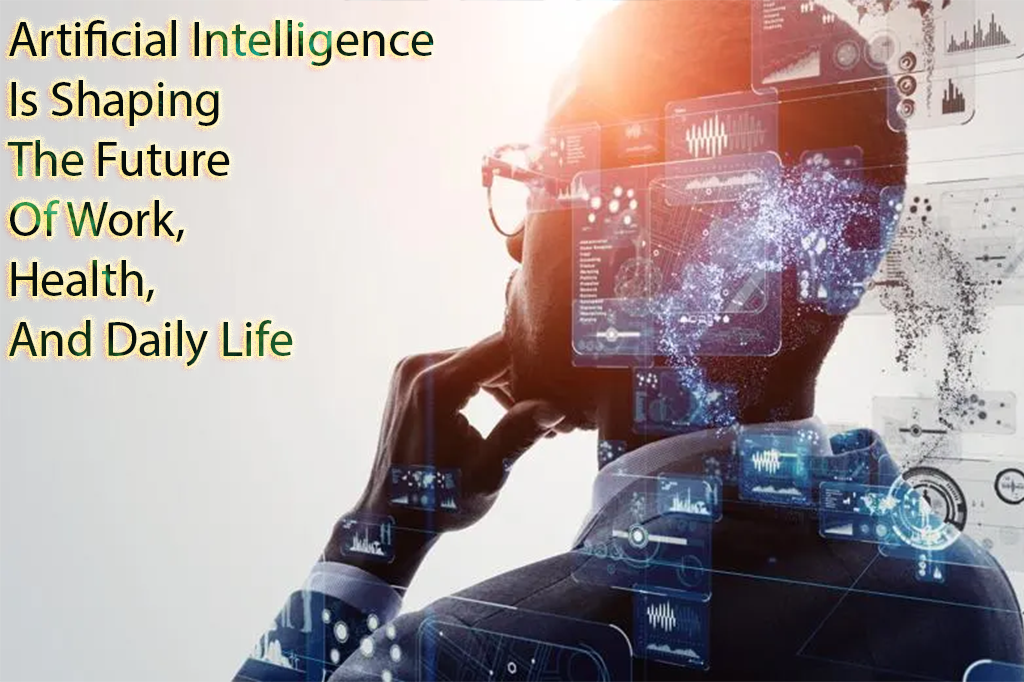
Artificial Intelligence (AI) is no longer just a buzzword. It has silently woven itself into nearly every aspect of our daily lives—sometimes so seamlessly that we hardly notice it. From personalized recommendations on Netflix to AI-driven fraud detection in banking, the technology is already here. But what lies ahead is far more revolutionary: a future where AI powers everything—our homes, workplaces, healthcare, mobility, and even creativity.
The AI Integration Wave 🌍
The 2020s have seen AI emerge as the “invisible engine” of digital transformation. Businesses and governments across the globe are betting big on AI to solve problems that once felt unsolvable—climate change predictions, faster drug discovery, real-time translation, and smart cities. By 2030, experts predict that AI could contribute over $15 trillion to the global economy, making it the single biggest technological driver of growth in history.
But this integration goes beyond economics. It’s reshaping how humans live, interact, and think. Soon, we won’t talk about AI as a separate technology—it will simply be the foundation on which our world runs.
Smarter Homes, Smarter Living 🏠
Imagine waking up in a home that knows you better than you know yourself. Your AI-powered assistant adjusts the lighting to mimic natural sunlight, plays your favorite morning playlist, and prepares your coffee exactly the way you like it. The fridge suggests healthy meal options based on your fitness goals, while AI sensors in the bathroom analyze your health in real time.
This isn’t science fiction. Companies like Amazon, Google, and Samsung are already embedding AI-powered ecosystems into homes, where devices learn from behavior and anticipate needs before we express them. The “Internet of Things” (IoT) becomes truly intelligent when AI turns raw data into meaningful actions.
Healthcare Revolution 🧬
Perhaps the most exciting promise of AI lies in healthcare. Traditional medicine often works reactively—treating patients after symptoms appear. AI flips that model to proactive, predictive care.
-
AI diagnostics can analyze medical images faster and more accurately than human radiologists.
-
Drug discovery platforms are cutting development times from years to months.
-
Wearable devices powered by AI track heart rhythms, blood sugar levels, and sleep quality—alerting both patients and doctors before a crisis happens.
-
In the future, nanobots guided by AI could repair damaged cells inside the human body.
Healthcare, once constrained by human expertise and time, is moving toward a world where AI doctors and digital twins simulate treatments on virtual versions of patients before applying them in real life.
Workplaces of the Future 💼
The workplace is undergoing an AI-driven metamorphosis. Routine tasks—from scheduling meetings to generating reports—are already automated. But the future goes deeper:
-
AI copilots will work alongside humans in coding, design, and research.
-
Customer service will shift almost entirely to conversational AI agents.
-
Recruitment will use algorithms that can assess not only skills but also team compatibility.
-
Decision-making in companies will be supported by predictive analytics that reduce risks and maximize opportunities.
Far from replacing humans, AI will likely augment them—allowing us to focus on creativity, strategy, and emotional intelligence, while machines handle repetitive or data-heavy tasks.
Mobility & Smart Cities 🚗🌆
AI is set to redefine how we move and live in urban spaces. Self-driving cars are only the beginning.
-
AI-powered traffic systems will minimize congestion by analyzing patterns in real time.
-
Public transportation will dynamically adjust routes based on demand.
-
Smart energy grids will balance supply and consumption using predictive models.
-
Drones powered by AI may deliver packages, medical supplies, or even serve as emergency responders.
Cities of the future will essentially run on AI—making them safer, cleaner, and more efficient.
Creativity and Entertainment 🎨🎶
One of the most surprising roles of AI is in creativity. Once thought to be uniquely human, creativity is now shared with machines. AI can generate music, paint digital art, write novels, and even create entire movies. Tools like ChatGPT, MidJourney, and Runway are blurring the line between human and machine-generated creativity.
This raises deep philosophical questions: if a song composed by AI moves us emotionally, is it any less “real” than one written by a human? In the coming decades, we may live in a world where human-AI collaboration produces entirely new art forms.
The Challenges Ahead ⚠️
While the promise of AI is immense, it also comes with serious challenges:
-
Ethics & Bias: AI learns from data, and biased data leads to biased decisions—impacting hiring, policing, and even healthcare.
-
Privacy: The more AI knows about us, the more vulnerable our personal data becomes.
-
Job Displacement: Entire industries may be disrupted, requiring large-scale reskilling of workers.
-
Control & Regulation: Who gets to decide how powerful AI systems are built and deployed?
These challenges demand global cooperation, ethical frameworks, and strong regulation to ensure AI benefits humanity as a whole.
A Future of Collaboration 🤝
The vision of “AI-powered everything” isn’t about replacing humans with machines—it’s about humans and AI working together. AI will not feel emotions, have values, or dream big; that remains uniquely human. What it will do is augment human potential, helping us solve problems faster, live healthier, and unlock opportunities we never imagined.
Just like electricity in the 19th century or the internet in the 20th, AI in the 21st century will be the invisible force powering everything around us. The real question is not whether AI will transform our lives—it already has—but whether we can guide it wisely toward a future where technology and humanity grow together.
