


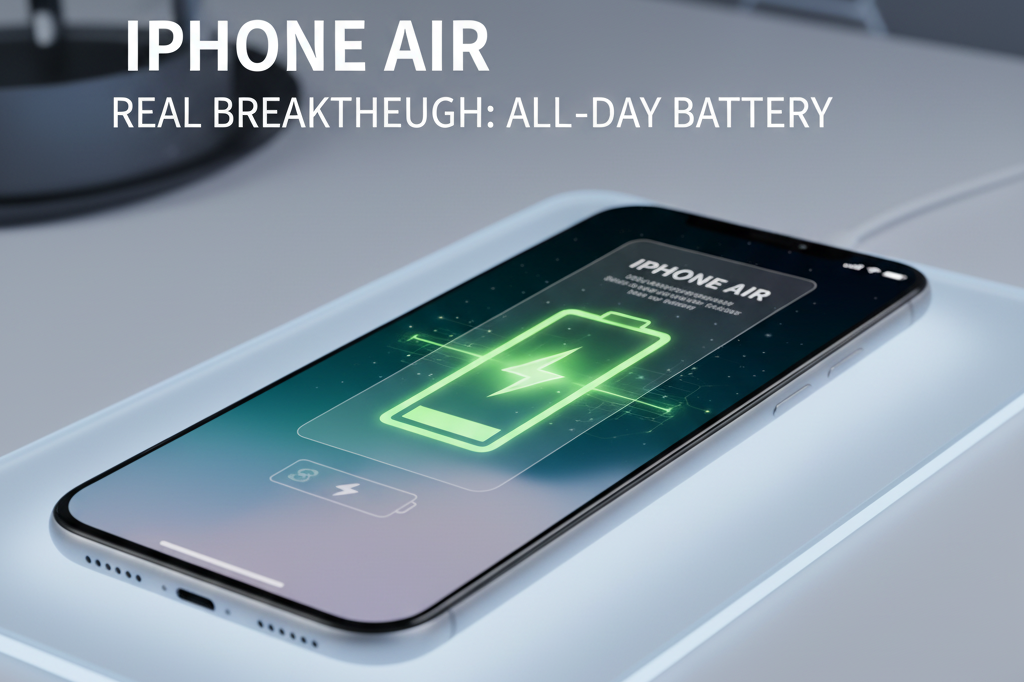
Apple has always been known for its ability to blend sleek design with powerful technology, but with the iPhone Air, the company may have achieved something even more groundbreaking than its usual engineering feats. While its ultra-thin body and miniaturized logic board capture immediate attention, experts believe the true revolution is hiding beneath the aluminum and glass enclosure — its battery technology.
A Radical Shift in Battery Design
Gene Berdichevsky, co-founder and CEO of Sila — a leading battery materials manufacturer — describes the iPhone Air’s battery as nothing short of remarkable. Berdichevsky isn’t just any commentator on this topic. As Tesla’s seventh employee and the lead engineer behind the original Tesla Roadster’s battery pack, he has spent decades at the forefront of energy storage innovation.
“The completely arbitrary, two-dimensional shape — you look at it, and it’s pretty amazing,” Berdichevsky explained. After a recent trip to Asia, where he examined some of these new battery cells, he concluded that Apple’s implementation represents “a revolutionary piece of battery tech.”
What Makes It Different? Metal Can Batteries
For years, Apple has relied on L-shaped lithium-ion batteries in its iPhones. While clever in maximizing space, these designs introduced weaknesses. Lithium-ion cells naturally expand over time, and the interior corners of an L-shaped battery became stress points that could lead to durability issues.
The iPhone Air replaces this with a metal can battery — a design that Apple has patented. Unlike the soft plastic pouch cells commonly used in smartphones, this approach involves encasing the entire cell in a rigid metal shell. This change delivers several advantages:
-
Durability: The rigid casing prevents swelling from deforming the battery, making it more robust.
-
Design Freedom: Apple can now shape batteries into almost any two-dimensional form, maximizing how much power fits inside the iPhone’s slim frame.
-
Edge-to-Edge Efficiency: The battery can be molded to fill tight, irregular spaces around circuit boards and other components.
In short, this innovation allows Apple to balance its obsession with slim designs without compromising performance or safety.
Why This Matters Beyond the iPhone
According to Berdichevsky, this shift is not only about one product. “You can now build batteries in any two-dimensional shape you want,” he noted, suggesting that this method could influence the entire consumer electronics market.
Devices like AR and VR glasses, which demand compact yet high-capacity batteries, could benefit even more from metal can construction. By fitting batteries into unconventional shapes, manufacturers can pack more energy into smaller footprints — a critical factor for wearable technology.
The Silicon Anode Connection
While Apple’s battery chemistry in the iPhone Air remains based on traditional graphite anodes, the adoption of metal can enclosures may set the stage for the next big leap: silicon anodes.
Why does this matter? Silicon anodes can store up to 50% more energy than graphite, meaning dramatically longer battery life for phones, laptops, and other devices. However, silicon tends to swell during charging cycles, creating challenges for conventional battery casings.
Metal can designs mitigate some of these issues by offering structural rigidity, giving manufacturers the freedom to explore higher-performance chemistries without as much risk. Companies like Sila are already producing advanced silicon-carbon composites that manage swelling, and Apple’s new enclosure style could make adopting this technology more practical.
Balancing Risk and Innovation
It’s telling that Apple hasn’t yet introduced silicon anodes in the iPhone Air. Launching an entirely new casing design is already a major risk. Pairing that with a new battery chemistry might have introduced too many variables at once.
As Berdichevsky put it: “If you’re bringing a new battery design online, you kind of go, ‘You know what? Let’s use yesterday’s chemistry.’”
This cautious approach means Apple can validate the durability and safety of the metal can design first. Once proven, it opens the door to layering in the next wave of energy-dense materials.
The Bigger Picture: A New Era of Batteries
The iPhone Air demonstrates how far consumer electronics have come in terms of battery innovation. For years, lithium-ion technology felt stagnant, with only incremental gains. Now, by rethinking not only what batteries are made of but how they’re packaged, Apple is pushing the industry toward a new era.
-
For Consumers: Longer battery life, thinner devices, and safer energy storage.
-
For Manufacturers: More freedom in design, enabling futuristic devices like lightweight AR headsets.
-
For the Industry: A stepping stone toward silicon-based energy storage, which could ripple across smartphones, laptops, wearables, and even electric vehicles.
Conclusion
At first glance, the iPhone Air impresses with its feather-light design and compact engineering. But the real story lies deeper inside. Apple’s metal can battery technology may well redefine what’s possible in portable electronics, paving the way for devices with greater energy density, more flexible form factors, and safer long-term performance.
Just as Berdichevsky’s work at Tesla reshaped the automotive battery landscape, Apple’s pivot in battery construction could set the stage for a new generation of mobile devices. Today, it powers the iPhone Air. Tomorrow, it might fuel the entire future of personal technology.
