


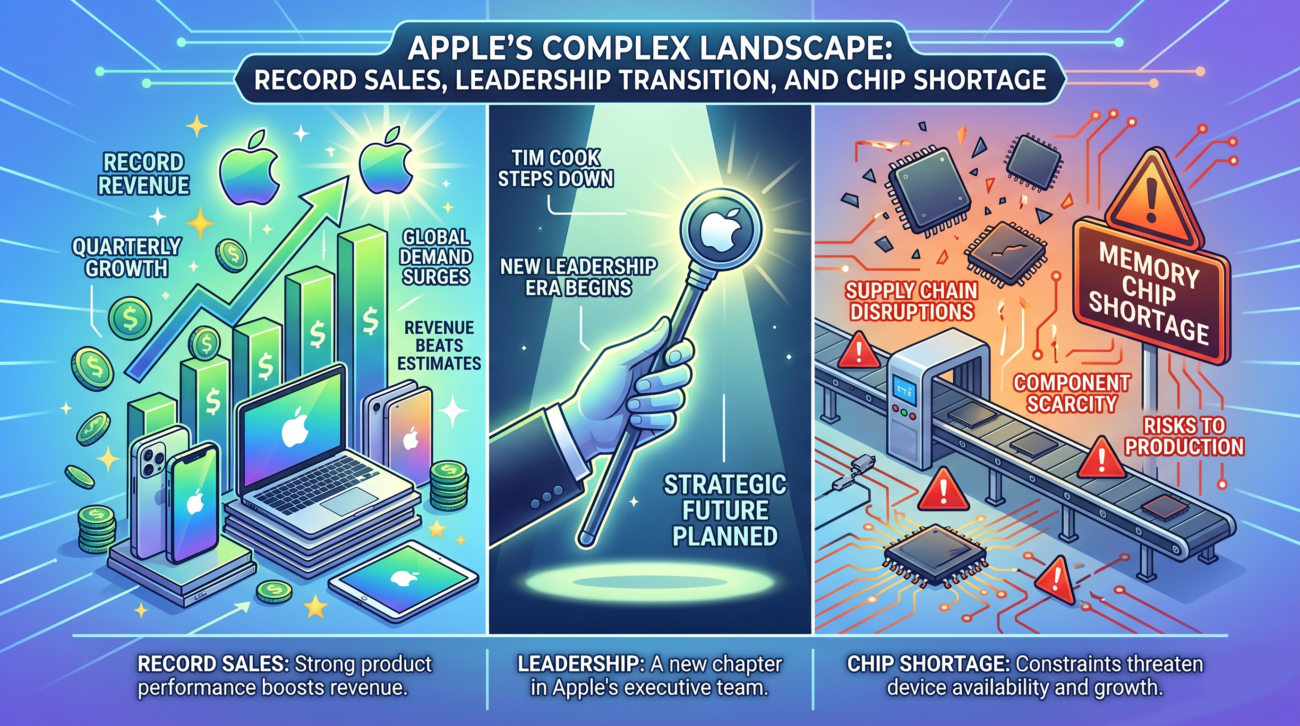
Apple has delivered one of its strongest March quarters ever, reporting revenue of $111.2 billion as demand for the iPhone 17 lineup remained strong across global markets. The results gave the company a major boost during a period of leadership transition, with Tim Cook preparing to step down as CEO later this year.
During Apple’s latest earnings call, Cook highlighted the company’s strong performance and said the iPhone achieved a March-quarter revenue record. The growth was supported by solid demand across several regions, showing that Apple’s core hardware business remains highly resilient even as the broader technology industry faces supply-chain pressure.
However, Apple also warned that rising memory chip costs could become a serious challenge in the coming months.
Memory Chip Costs Are Becoming a Bigger Problem
Cook said Apple paid more for memory chips during the March quarter compared with previous periods. The company was able to reduce the impact by using existing inventory, but that advantage may not last.
According to Apple, memory prices are expected to rise further in June and beyond. This could put pressure on Apple’s margins, especially because products like the iPhone, iPad, Mac, and other devices depend heavily on memory components.
The shortage is being linked to rising demand from the artificial intelligence industry. AI companies require massive amounts of memory for servers, data centers, and high-performance computing systems. As a result, global memory supply is becoming tighter, pushing prices higher for consumer electronics manufacturers.
iPhone Prices Could Be Affected
The iPhone is Apple’s most important product category, so higher component costs could directly affect the company’s future pricing strategy. If memory prices continue to climb, Apple may have less room to absorb those costs internally.
That means future iPhone models could become more expensive, or Apple may need to adjust storage options, production planning, or profit expectations.
Cook also noted that the supply chain currently has less flexibility than usual, making it harder for companies to quickly secure additional components when demand increases.
John Ternus Will Take Over During a Difficult Period
Apple’s leadership change adds another layer of importance to the situation. John Ternus, Apple’s senior vice president of hardware engineering, is set to become the company’s next CEO on September 1, 2026. Cook will remain involved as executive chairman, giving Apple continuity during the transition.
Ternus praised Cook during the earnings call and said taking over as CEO is a major honor. Still, his first months in charge may not be easy. He will inherit a company with record sales, but also rising supply-chain risks, increasing AI competition, and pressure to keep the iPhone business growing.
Apple Remains Strong, But Risks Are Building
Apple’s latest results show that customer demand remains strong, especially for the iPhone 17 lineup. But the warning about memory chip prices suggests that even Apple is not fully protected from the global AI-driven hardware squeeze.
For now, Apple has momentum on its side. The company is generating record revenue, its iPhone business is performing well, and Cook will continue supporting the company after stepping down as CEO.
But as memory costs rise and supply becomes tighter, Apple’s next leadership era could begin with one of its biggest supply-chain tests in years.
