


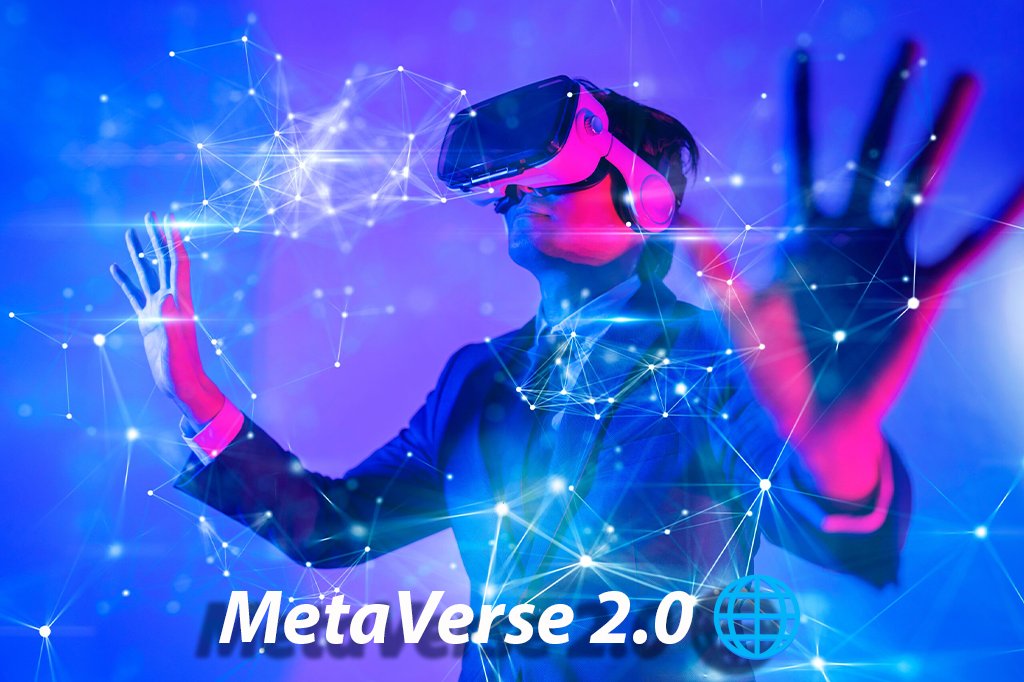
From VR headsets to full-immersion experiences—the metaverse is on the brink of a massive transformation. What started as a virtual playground for gamers and tech enthusiasts is evolving into Metaverse 2.0, a new era of interconnected digital worlds powered by AI, blockchain, augmented reality (AR), and brain-computer interfaces.
While the early vision of the metaverse was dominated by bulky VR headsets and pixelated avatars, the future promises far more. In Metaverse 2.0, our digital identities, economies, and interactions will be indistinguishable from real life, opening up opportunities—and challenges—that will shape the future of human connection.
🌐 What is Metaverse 2.0?
The term “Metaverse 2.0” refers to the next stage of digital evolution, where immersive technologies converge to create hyper-personalized, persistent virtual environments. Unlike the first wave, which was largely experimental and focused on gaming, Metaverse 2.0 will integrate:
-
AI-powered environments that adapt to user behavior in real time.
-
Web3 and blockchain economies, enabling true digital ownership of assets, land, and identities.
-
Cross-platform integration, making digital worlds accessible through VR, AR glasses, smartphones, and even neural interfaces.
In essence, Metaverse 2.0 aims to blur the line between physical and virtual reality, creating a “mirror world” that feels as real as the one outside your window.
🎮 Gaming & Entertainment in the New Era
Gaming was the foundation of the metaverse, but in its new form, it will expand into fully immersive entertainment ecosystems.
-
Haptic suits and gloves will allow players to “feel” the virtual environment. Imagine fighting dragons and actually sensing the heat of their fire.
-
Neural interfaces will bypass traditional controllers, letting users control avatars with their thoughts.
-
Entertainment industries are also embracing this shift: virtual concerts, sports events, and even movies will be interactive, immersive experiences. Instead of watching a film, you could walk through its world as a participant.
Platforms like Epic Games, Roblox, and Meta’s Horizon Worlds are already experimenting with this, but Metaverse 2.0 will take it to cinematic levels.
🏢 The Future of Work: Virtual Offices 2.0
The pandemic normalized remote work, but Metaverse 2.0 will redefine it entirely.
-
Instead of staring at flat screens, workers will enter 3D collaborative environments where meetings feel as natural as being in the same room.
-
Virtual whiteboards, lifelike avatars, and AI-driven assistants will boost productivity.
-
Companies could maintain persistent virtual campuses, where employees “log in” with VR or AR devices instead of commuting.
Imagine putting on lightweight AR glasses and instantly entering your digital office—complete with coworkers, holographic presentations, and real-time collaboration tools.
💰 The Rise of the Metaverse Economy
One of the most groundbreaking aspects of Metaverse 2.0 is the emergence of a self-sustaining digital economy.
-
Decentralized finance (DeFi) and NFT marketplaces will enable users to buy, sell, and trade digital assets securely.
-
Virtual land ownership, digital fashion, and in-game assets will have real-world value.
-
AI-driven avatars could even act as “digital employees,” offering services, generating content, or representing companies in virtual worlds.
For businesses, this means new revenue streams—from advertising in immersive spaces to launching metaverse-native products and services.
🧠 Neural Interfaces & Full Immersion
If VR headsets defined Metaverse 1.0, neural interfaces will define Metaverse 2.0.
Companies like Neuralink and Kernel are working on brain-computer interfaces that connect directly to neural signals. In the metaverse, this could allow:
-
Thought-based control, where users navigate digital environments with their minds.
-
Sensory feedback, making virtual experiences indistinguishable from physical ones.
-
Memory sharing and cognitive enhancement, pushing the boundaries of human communication.
This leap could eliminate the barrier of clunky headsets altogether, bringing us closer to a Matrix-like immersion.
🧬 Social Life & Identity in Metaverse 2.0
The metaverse isn’t just about tech—it’s about people. In Metaverse 2.0:
-
Avatars will become hyper-realistic, powered by AI emotion recognition and motion capture.
-
Social spaces will replicate real-world gatherings—cafes, clubs, universities—but with limitless creative possibilities.
-
Digital identities will carry weight across multiple platforms, making the virtual self as important as the physical one.
This raises questions about privacy, identity theft, and digital rights, but also offers new forms of expression and freedom.
⚖️ Challenges of Metaverse 2.0
With great innovation comes great responsibility. Metaverse 2.0 faces several challenges:
-
Data privacy: With more sensors and neural inputs, personal data becomes highly sensitive.
-
Digital addiction: Hyper-realistic immersion could make people prefer digital life over physical reality.
-
Inequality: Access to high-end devices and connectivity may create digital class divides.
-
Regulation & ethics: Who owns digital land? How do we regulate avatars? Who controls AI-driven spaces?
These questions must be addressed before Metaverse 2.0 becomes mainstream.
🔮 What’s Next for Digital Worlds?
Metaverse 2.0 isn’t just about better graphics or smarter AI—it’s about redefining human interaction. We’re moving from passive screen time to active digital existence, where every aspect of life—work, play, learning, and even health—can happen in immersive environments.
The ultimate goal? A seamless fusion of physical and digital realities, where the metaverse isn’t just a place we visit but a space we live in. While this vision raises concerns, it also opens doors to innovations that could transform education, medicine, and global collaboration.
