


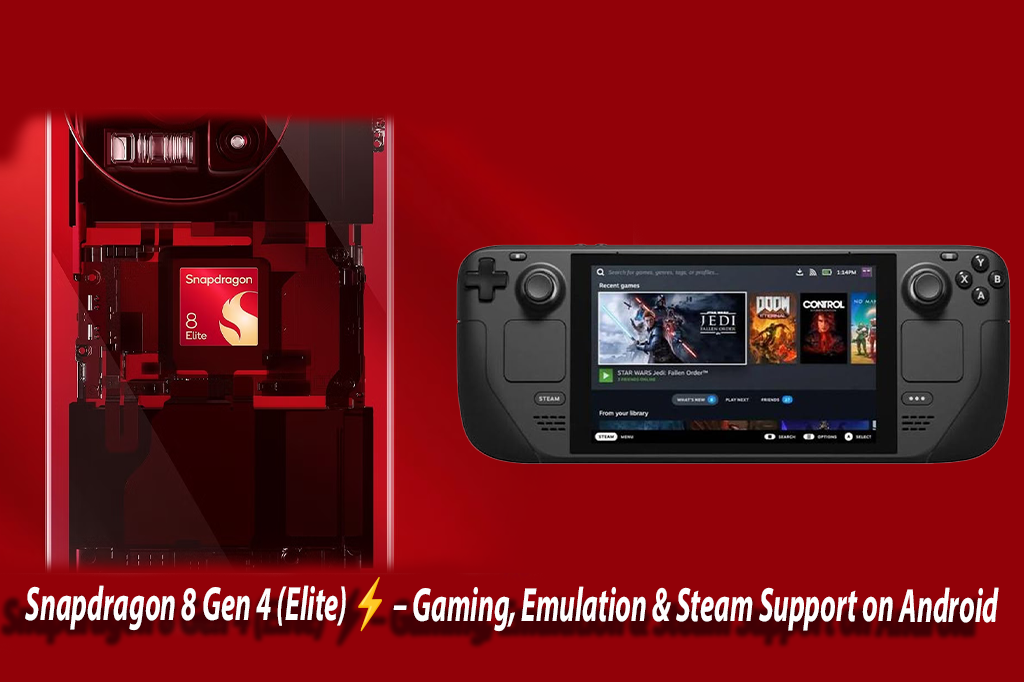
The line between PC gaming and mobile gaming is fading faster than ever. With the arrival of Qualcomm’s Snapdragon 8 Gen 4 Elite, Android smartphones are no longer just communication tools—they’re becoming handheld gaming consoles capable of running everything from AAA Android titles to emulated PC and console games.
But how powerful is this new chip? Can it really compete with devices like the Steam Deck or even lightweight gaming laptops? And how does it handle advanced gaming features like Frame Generation, FSR 4, and PSSR upscaling?
Let’s dive in.
Snapdragon 8 Gen 4 Elite: A Powerhouse for Mobile Gaming
Qualcomm’s Snapdragon 8 Gen 4 Elite is built on a cutting-edge 3nm TSMC node, making it the most efficient Snapdragon ever. It’s designed to balance high performance and thermal efficiency for sustained gaming sessions.
Key specs:
-
CPU: Custom Oryon cores, clocked up to 4.26GHz
-
GPU: Adreno 830 with ray tracing support & Vulkan 1.3 API
-
Benchmark Score: ~2.73M on AnTuTu v10 (NanoReview)
-
Graphics Power: ~3.68 TFLOPS FP32 performance (For Galaxy variant)
In short: this is desktop-class performance in your pocket.
Steam Deck vs Snapdragon 8 Gen 4 Elite: Benchmark Showdown
Here’s where it gets exciting—Snapdragon 8 Elite actually outperforms the AMD APU inside the Steam Deck.
Geekbench 6 Scores:
| Device | Single-Core | Multi-Core |
|---|---|---|
| Snapdragon 8 Gen 4 Elite | 3,196 | 10,142 |
| Valve Steam Deck (AMD APU) | ~1,278 | ~4,365 |
That’s 2.5x faster single-core and 2.3x faster multi-core than the Steam Deck.
This means Android phones running Snapdragon 8 Elite are now powerful enough to emulate PC games and run Steam titles that were previously exclusive to handheld PCs.
Emulation Performance: A Dream for Retro & PC Gamers 🎮
One of the biggest breakthroughs is emulation. Thanks to robust GPU drivers and Linux kernel support, Snapdragon 8 Gen 4 Elite can run emulators far more efficiently than competing chips.
✅ Dolphin Emulator (GameCube/Wii): Runs almost all games at full speed.
✅ AetherSX2 / PCSX2 (PS2): Demanding titles like God of War II run flawlessly.
✅ Citra (3DS): Excellent performance across the board.
✅ Yuzu / Skyline (Nintendo Switch): Playable results on many AAA Switch games.
✅ x86 Emulation / Steam Games: Experimental but promising—several Steam titles boot and run.
This effectively turns flagship Android phones into all-in-one retro handhelds that rival devices like the Steam Deck, Asus ROG Ally, or even GPD Win handhelds.
Frame Generation, FSR 4 & PSSR: Desktop-Grade Features on Mobile 📈
Another leap is the integration of advanced upscaling and frame interpolation technologies.
-
FSR 4 (FidelityFX Super Resolution): AMD’s upcoming upscaler could be supported on mobile, improving frame rates while keeping visuals sharp.
-
PSSR (PlayStation Spectral Super Resolution): Sony’s AI-based upscaler might influence mobile rendering pipelines, particularly for cloud gaming.
-
Frame Generation (AI-driven interpolation): Qualcomm is experimenting with similar techniques, potentially doubling frame rates on demanding games.
This means Snapdragon 8 Elite phones could run AAA games at 120–144fps even when rendering at lower resolutions.
Thermal Performance & Sustained Gaming 🔥
One of the biggest challenges with high-performance mobile chips is heat. Sustained gaming often leads to throttling, reducing frame rates over time.
However, Snapdragon 8 Gen 4 Elite introduces:
-
Improved thermal dissipation via vapor chamber cooling (on gaming phones).
-
AI-based workload management to reduce overheating.
-
Better power efficiency from the 3nm process, meaning less battery drain per frame.
For long gaming sessions, this is crucial—your phone can maintain stable 90–120fps performance without burning your hands.
Gaming on Android: Beyond Mobile Titles 📱🎮
The Snapdragon 8 Elite doesn’t just crush benchmarks—it expands what Android gaming means.
-
AAA Mobile Titles: Games like Genshin Impact, Call of Duty Mobile, and PUBG Mobile run at max settings effortlessly.
-
Steam Link & Xbox Cloud Gaming: Combined with fast 5G/Wi-Fi 7, mobile cloud gaming becomes indistinguishable from local play.
-
Native Steam Support via Linux Emulation: Experimental, but steadily improving—some indie and older AAA PC games already run natively.
This effectively blurs the line between mobile gaming and PC handheld gaming.
Future-Proofing: 8 Years of Updates
Another game-changer is Qualcomm’s and Google’s partnership promising 8 years of software and security updates for Snapdragon-powered devices.
This means a phone you buy in 2025 with Snapdragon 8 Gen 4 Elite will remain relevant until 2033—a huge leap forward for Android gaming longevity.
Verdict: Snapdragon 8 Gen 4 Elite = Portable PC Gaming in Your Pocket 🚀
| Category | Snapdragon 8 Gen 4 Elite |
|---|---|
| Performance | ~2.73M AnTuTu, beats Steam Deck |
| Graphics | Adreno 830 w/ ray tracing |
| Emulation | Runs PC, PS2, Switch smoothly |
| Frame Tech | FSR 3, FrameGen support |
| Thermals | Better sustained gaming |
| Longevity | 8 years of updates |
The Snapdragon 8 Gen 4 Elite isn’t just a mobile chip—it’s a paradigm shift. It makes Android phones legitimate PC gaming handhelds, rivals the Steam Deck, and sets the stage for next-gen emulation and cloud gaming.
If you’re a gamer, emulator enthusiast, or power user, 2025’s flagship Snapdragon phones are no longer “just phones.” They’re next-gen portable gaming PCs.
